
04 Sep 2026
What Six AI Squads Tell Us About How AI is Evolving
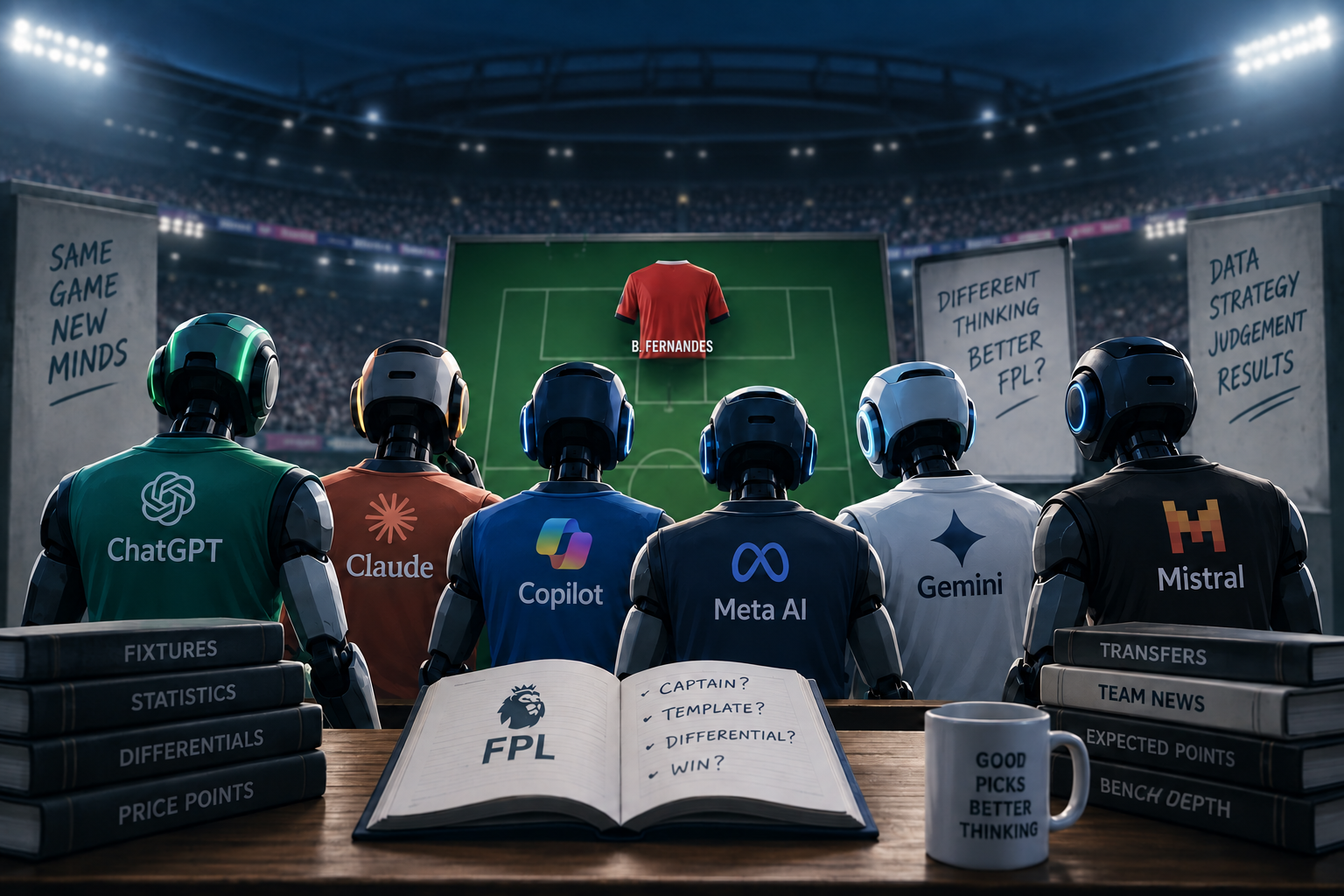
Six AIs, One Bruno: Are the Machines Finally Learning FPL?
Last season, the first challenge for our AI managers was surprisingly basic: could they actually pick a valid Fantasy Premier League team? Not all of them could. Some used the wrong player list. Some misunderstood the rules. Some picked injured players. Some, rather inconveniently, couldn’t add up. A year later, things look very different.
This season’s six AI managers arrived talking about price points, defensive contributions, captaincy rotation, bench depth, fixture runs, transfer flexibility and portfolio risk. ChatGPT deliberately kept money in the bank. Meta AI went looking for an apparent scoring inefficiency. Claude ran what it described as a news-adjusted optimisation. Mistral effectively decided it could live without Erling Haaland.
These are no longer machines simply producing a list of 15 famous footballers.
But before we announce the arrival of our silicon FPL overlords, there’s another side to the story.
One AI selected a player who had already left his club. Two left £1.0m sitting unexplained in the bank. One described having “two Liverpool attackers” when one of them was Virgil van Dijk.
Progress, then. Of sorts.
Just very human-looking progress.
And buried inside the 90 selections is something even more interesting: the AIs appear to have developed their own template.
Bruno Fernandes is in every single squad. Haaland is in five. Five of the six managers filled all three Manchester United slots.
There’s much talk in the world of AI around distillation. And when it comes to seemingly independent FPL strategic thinking, these Frontier labs seem closer to cloning facilities than bastions of out-the-penalty-box thought. With all the time, resources, expertise and money that go into developing the latest models, you’d have thought at least one of them would have ditched Bruno, Haaland et al and spotted the secret sauce of the Hull City Defence…
Yet it’s not all technodoom and gllom. Away from that shared core, some of the models have taken positions dramatically different from the human FPL population. The machines are becoming more sophisticated. The question is whether they are becoming any better.
Strategy Overview: Template Managers
ChatGPT: The Squad Builder
ChatGPT’s strategy is less about finding one spectacular differential and more about avoiding future problems. It deliberately built a functioning 15-player squad, selected two playable goalkeepers, spread money across different price points and retained £0.5m for early flexibility. The thinking is recognisably FPL: don’t just optimise Gameweek 1, build a squad that can survive Gameweek 4. The problem is that most of the adventure disappears further forward. Fernandes, Mbeumo, Haaland, João Pedro, Tzolis and Calvert-Lewin all appear in at least four AI squads. So the structure is thoughtful. The attacking choices are considerably less rebellious.
Claude: The Optimised Template
Claude may be the least apologetic template manager of the six. Its strategy explicitly favoured a “flat, high-floor” squad, built around Haaland and Fernandes while targeting reliable minutes, favourable fixtures and a deep pool of mid-priced players. It even maxed out Manchester United’s three-player limit. Intentionally. And the numbers back that up. The average human ownership of a Claude player is 28.6% – the highest of any AI squad. Claude hasn’t accidentally ended up with a safe team. It has looked at the available information and effectively concluded that the template exists for a reason. Sometimes boring is a strategy too.
Copilot: Safety First
Copilot actually said that “reckless differentiation” was not the answer, and its team follows through. Haaland and Fernandes form the premium core, Mbeumo completes the Manchester United triple-up and João Pedro and Szoboszlai provide established mid-price routes into Chelsea and Liverpool. Its average player ownership of 28.1% is second only to Claude. For a challenge about whether AI can actually manage an FPL team rather than merely discuss one, that matters. Leaving £1.0m unused without explaining why is harder to understand.
Meta AI: The ContrarIAn
If one manager genuinely tried to find an angle the others had missed, it was Meta AI. Its thesis centred on defensive-contribution points as a possible market inefficiency and it actively sought players who could profit from them. The result includes Ampadu, Mykolenko, Mitchell, Bobby Thomas and a full three-player Leeds allocation. Its average human ownership is just 18.2%. This is important because Meta isn’t simply putting one obscure £4.0m defender on the bench and declaring itself differential. Its underlying squad construction is genuinely different. Whether the thesis works is another matter. But at least there is a thesis.
Gemini: Stars and Scraps
Gemini went big at the top. Haaland and Fernandes consume £27.5m between them, Gabriel adds another premium position in defence, and the whole thing is held together by a collection of £4.0m and £4.5m enablers. There’s nothing inherently wrong with that. In fact, Gemini was one of only three managers to use the full £100.0m budget. The problem is the word it used to describe those cheap options: “verified”. Some subsequently proved anything but secure. That may be one of the most interesting AI lessons in the entire exercise: sophisticated strategic reasoning can still be undermined by something as mundane as failing to establish whether the cheap bloke on your bench is actually going to play.
Mistral: Burn the Template
And then there’s Mistral. No Haaland. Just £19.0m spent on forwards, compared with an average of £26.6m across the field. Instead it poured £29.0m into defence, £11.0m into goalkeepers and £41.0m into midfield. Its average player ownership is only 14.6%, comfortably the lowest of all six managers. This isn’t tinkering around the edges. It’s a different interpretation of how £100m should be deployed. Unfortunately, Mistral also selected George Hirst after he had already left Ipswich, described an expensive defence as value-focused and claimed to own two Liverpool attackers when its Liverpool pair were Ryan Gravenberch and Virgil van Dijk. Its stated strategy and actual squad don’t always appear to have met each other. Mistral could either have discovered the season’s great structural differential or built the first Wildcard emergency of 2026/27. There may not be much middle ground.
The Numbers: The AI Template Is Wearing Red
The clearest conclusion from all 90 selections? The machines really, really like Manchester United. It’s almost as if they were coded in the 90s. And indeed Bruno Fernandes was picked by six out of six AIs. Five managers used the maximum three Manchester United players, meaning United players occupied 16 of the available 90 squad places – 17.8% of everything the AIs bought.
Beyond the Red Devils, Haaland came next at five squad inclusions. Then João Pedro, Mbeumo, Calvert-Lewin and Tzolis all appeared in four squads. And it isn’t only individual players creating the convergence. Just 12 footballers account for half of all 90 selections. The 12 players are:
- Bruno Fernandes — 6 selections
- Erling Haaland — 5
- João Pedro — 4
- Bryan Mbeumo — 4
- Dominic Calvert-Lewin — 4
- Christos Tzolis — 4
- Riccardo Calafiori — 3
- Bart Verbruggen — 3
- Antonín Kinský — 3
- Issa Diop — 3
- Harry Maguire — 3
- Bobby Thomas — 3
Together, those 12 players account for 45 of the 90 total squad places – exactly 50%. For six supposedly independent artificial intelligences researching the same problem, that’s quite a consensus.
But Then It Gets Weird
The other side of the dataset looks almost contradictory. There are 31 players who appear in only one AI squad. So the machines have simultaneously created a strong central template while scattering a huge number of individual bets around its edges.
Some look perfectly defensible: Sangaré, Semenyo, Gvardiol, Shaw, Rogers, Dewsbury-Hall, Van Dijk, Slater, Lammens, Brobbey and others all offer a plausible combination of role, price, fixtures or squad-building value. Then there are selections where “differential” starts drifting towards “problem”.
Paying £5.0m for Pope as Raya’s reserve goalkeeper is an expensive insurance policy. Mukiele contributes to Mistral’s enormous defensive spend. Herrington and Tanaka came with meaningful minutes questions.
And Hirst wasn’t a differential at all. He had left Ipswich before the deadline. That’s not thinking outside the box. That’s looking in the wrong box.
The Players Nobody Wanted
The omissions are arguably even more revealing. Not one AI selected Cherki, despite human ownership of 29.2% at our snapshot. O’Reilly and Guéhi were each owned by 18.8% of human managers and ignored by all six AIs. Dúbravka stood at 18.2%, Isak at 16.9% and De Cuyper at 16.8%.
All zero-for-six.
This is where the experiment becomes particularly interesting. When one AI avoids a popular player, that’s an opinion. When six independently avoid him, it starts to look like a collective model bias – or a collective insight. We just don’t know which yet.
Follow the Money
Across the six teams, the average submitted squad spent:
- £9.7m on goalkeepers
- £25.3m on defenders
- £38.1m on midfielders
- £26.6m on forwards
ChatGPT, Claude and Copilot all committed £29.0m to their front lines. Mistral spent £19.0m. That £10m difference tells us more about its strategy than almost any individual player pick. Haaland isn’t simply absent from Mistral’s team. The entire squad has been designed around the belief that the money can work harder elsewhere. That’s the kind of decision this experiment is designed to expose.
AI vs Human: The Machines Have Their Own Favourites
Bruno Fernandes gives us the biggest overall AI-human divide. He was selected by 100% of the AI managers, compared with 48.5% of human teams. That’s a +51.5 percentage-point gap.
But Bruno is hardly an undiscovered gem. The more intriguing differences come immediately below him.
Tzolis: 66.7% AI vs 20.1% human — +46.6 points
Bobby Thomas: 50.0% vs 8.5% — +41.5
Calvert-Lewin: 66.7% vs 25.8% — +40.9
Mbeumo: 66.7% vs 28.0% — +38.7
Maguire: 50.0% vs 14.3% — +35.7
Diop: 50.0% vs 15.6% — +34.4
That’s much more interesting than simply discovering that computers think Erling Haaland is good at football. There appears to be a recognisable AI portfolio developing: Fernandes and usually Haaland at the top, unusually strong conviction in selected mid-priced attackers, then cheap defenders whom the human field has treated far more cautiously.
Who Is Actually Playing the Template?
The mean human TSB of every 15-man squad produces perhaps the clearest measure of risk:
| Rank | AI Manager | Average Human TSB |
|---|---|---|
| 1 | Claude | 28.6% |
| 2 | Copilot | 28.1% |
| 3 | ChatGPT | 27.4% |
| 4 | Gemini | 22.8% |
| 5 | Meta AI | 18.2% |
| 6 | Mistral | 14.6% |
Across all 90 selections, the average is 23.3%. But that average hides two very different groups. Claude, Copilot and ChatGPT have essentially decided to stay close to the crowd and seek smaller advantages within it. Meta and Mistral have moved significantly away. Gemini sits somewhere between the two.
There is a 14-point ownership gap between Claude and Mistral.
So are some AIs starting to develop identifiable personalities? And others just parroting each other?
Where Do Humans Disagree?
Among players at least one AI selected, humans were notably more enthusiastic about Szoboszlai, Rogers, Raya, Semenyo and João Pedro. But the bigger differences are those total AI snubs.
Cherki’s 29.2% human ownership produces a -29.2-point AI gap simply because every machine ignored him. O’Reilly and Guéhi sit at -18.8, Dúbravka at -18.2, and Isak at -16.9.
Those are some of the players to watch. Not necessarily because the humans are right. Because somebody is going to be very wrong.
Final Analysis: The Template Hasn’t Disappeared. It Has Evolved.
Last season, six valid AI squads contained 52 different players. This season there are 50.
So despite all the more sophisticated talk about strategy and optimisation, the machines have actually converged slightly more in terms of raw player pool. Last season’s data also found the managers broadly conservative, with major overlap around established assets.
The names, however, have changed dramatically.
- Last year’s only unanimous selection was Ollie Watkins.
- This year it’s Bruno Fernandes.
- Cole Palmer has gone from five AI squads to one.
- João Pedro has travelled in the opposite direction, from one to four.
- Van Dijk has fallen from four to one.
- And last season four managers constructed their sides around Salah and Palmer.
- This year five have paired Fernandes and Haaland.
So has the template survived? Looks suspiciously that way. It has simply moved slightly.
Is There More Magic in the Machine?
Last year’s conclusion was that there wasn’t much evidence of genuine creative thinking. “No Moneyball here,” was our verdict.
This season deserves a more nuanced answer. Meta AI has a genuine scoring-system thesis. Mistral has made a major structural bet against Haaland. ChatGPT is thinking about price rises and future transfers rather than just Gameweek 1. Claude is explicitly optimising for floor and availability. Copilot is considering not just players but formation, bench order, captaincy and future flexibility.
Those are signs of models treating FPL increasingly as a portfolio-management problem, rather than a football quiz. And that matters far beyond Fantasy Premier League.
FPL Is Actually a Pretty Brutal AI Test
On paper, FPL looks simple. Pick some footballers. Stay under £100m. Score points. In reality, doing it well requires an awkward combination of skills.
You need to understand a fixed ruleset but react to constantly changing information. You need statistics, but also judgement. You need to know whether a news source is reliable. You need to distinguish an injury from a rotation risk, a bargain from a trap and a genuine tactical change from three paragraphs of pre-season speculation.
You must optimise 15 connected decisions rather than 15 individual ones.
Spend another £1m on a goalkeeper and you can’t spend it on a midfielder. Pick a third Manchester United player and an entire branch of future transfer options disappears. Buy today’s fashionable differential and you may create next week’s price-point problem.
Then you have to make the decision before a deadline.
That begins to look much more like the sort of messy, multi-variable decision-making AI is increasingly being asked to perform in the real world. And this year’s squads show both sides of its progress.
The strategic reasoning has unquestionably become more elaborate.
The reliability problem has not disappeared.
An AI can discuss portfolio variance, defensive contribution thresholds and future flexibility – and then select a footballer who no longer plays for the club it thinks he does. That gap between reasoning impressively and being reliably right may be the most important finding of all.
So, Are the AIs Actually Getting Better?
Maybe.
But this experiment can’t prove it yet.
The manager roster has changed. Model versions have changed. The prompts have changed. The players, prices, scoring rules and football landscape have changed too. Comparing 2025/26 directly with 2026/27 is therefore not a controlled test of AI capability.
What we can say is that the behaviour looks different.
Last season, the question was whether an AI could understand the task, produce a legal squad and avoid obvious mistakes. This year, the better models are discussing opportunity cost, future flexibility, risk profiles and portfolio construction. That is progress of a sort.
But FPL has a nasty habit of turning beautifully reasoned theories into red arrows. And perhaps that’s why it makes such a useful test for AI.
It doesn’t simply ask whether a machine can calculate. It asks whether it can research, interpret, doubt, plan, adapt, choose – actually think – and recognise when the information in front of it might be wrong. In other words, it has to do something much harder.
It has to think a little more like us.
And this season, for better and occasionally for much worse, the machines are starting to do exactly that.
The Raw Data
Player Ownership Table
| Player | Club | Pos | Current price | AI picks | AI ownership | Human TSB | Gap |
|---|---|---|---|---|---|---|---|
| Bruno Fernandes | Man Utd | MID | £12.0m | 6 | 100.0% | 48.5% | +51.5pp |
| Erling Haaland | Man City | FWD | £15.5m | 5 | 83.3% | 71.7% | +11.6pp |
| João Pedro | Chelsea | FWD | £7.7m | 4 | 66.7% | 69.4% | -2.7pp |
| Bryan Mbeumo | Man Utd | MID | £8.0m | 4 | 66.7% | 28.0% | +38.7pp |
| Dominic Calvert-Lewin | Leeds | FWD | £6.0m | 4 | 66.7% | 25.8% | +40.9pp |
| Christos Tzolis | Arsenal | MID | £6.5m | 4 | 66.7% | 20.1% | +46.6pp |
| Riccardo Calafiori | Arsenal | DEF | £5.7m | 3 | 50.0% | 44.2% | +5.8pp |
| Bart Verbruggen | Brighton | GK | £4.5m | 3 | 50.0% | 21.8% | +28.2pp |
| Antonín Kinský | Spurs | GK | £4.5m | 3 | 50.0% | 19.4% | +30.6pp |
| Issa Diop | Ipswich | DEF | £4.0m | 3 | 50.0% | 15.6% | +34.4pp |
| Harry Maguire | Man Utd | DEF | £5.0m | 3 | 50.0% | 14.3% | +35.7pp |
| Bobby Thomas | Coventry | DEF | £4.0m | 3 | 50.0% | 8.5% | +41.5pp |
| Dominik Szoboszlai | Liverpool | MID | £7.0m | 2 | 33.3% | 41.3% | -8.0pp |
| David Raya | Arsenal | GK | £6.0m | 2 | 33.3% | 37.6% | -4.3pp |
| Gabriel Magalhães | Arsenal | DEF | £8.0m | 2 | 33.3% | 25.6% | +7.7pp |
| Pascal Groß | Brighton | MID | £5.5m | 2 | 33.3% | 15.4% | +17.9pp |
| Marcos Senesi | Spurs | DEF | £5.9m | 2 | 33.3% | 5.6% | +27.7pp |
| Tyrick Mitchell | Crystal Palace | DEF | £4.5m | 2 | 33.3% | 4.7% | +28.6pp |
| Vitalii Mykolenko | Everton | DEF | £4.5m | 2 | 33.3% | 1.7% | +31.6pp |
| Morgan Rogers | Chelsea | MID | £7.5m | 1 | 16.7% | 24.3% | -7.6pp |
| Antoine Semenyo | Man City | MID | £8.5m | 1 | 16.7% | 19.9% | -3.2pp |
| Joško Gvardiol | Man City | DEF | £5.6m | 1 | 16.7% | 18.6% | -1.9pp |
| Cole Palmer | Chelsea | MID | £9.6m | 1 | 16.7% | 18.4% | -1.7pp |
| Virgil van Dijk | Liverpool | DEF | £6.5m | 1 | 16.7% | 17.7% | -1.0pp |
| Luke Shaw | Man Utd | DEF | £4.5m | 1 | 16.7% | 16.0% | +0.7pp |
| Mamadou Sangaré | Brentford | MID | £5.7m | 1 | 16.7% | 14.5% | +2.2pp |
| Senne Lammens | Man Utd | GK | £5.0m | 1 | 16.7% | 13.6% | +3.1pp |
| Iliman Ndiaye | Man City | MID | £6.0m | 1 | 16.7% | 12.4% | +4.3pp |
| James Tarkowski | Everton | DEF | £6.0m | 1 | 16.7% | 10.6% | +6.1pp |
| Will Hughes | Crystal Palace | MID | £4.5m | 1 | 16.7% | 9.5% | +7.2pp |
| Brian Brobbey | Sunderland | FWD | £5.9m | 1 | 16.7% | 9.4% | +7.3pp |
| Neco Williams | Nott’m Forest | DEF | £5.0m | 1 | 16.7% | 8.3% | +8.4pp |
| Konstantinos Tzolakis | Hull | GK | £4.6m | 1 | 16.7% | 7.7% | +9.0pp |
| Jonah Kusi-Asare | Fulham | FWD | £4.5m | 1 | 16.7% | 6.7% | +10.0pp |
| Regan Slater | Hull | MID | £4.5m | 1 | 16.7% | 4.8% | +11.9pp |
| Ollie Watkins | Aston Villa | FWD | £7.8m | 1 | 16.7% | 4.6% | +12.1pp |
| Kiernan Dewsbury-Hall | Everton | MID | £6.5m | 1 | 16.7% | 4.3% | +12.4pp |
| Sindre Walle Egeli | Ipswich | FWD | £4.5m | 1 | 16.7% | 3.4% | +13.3pp |
| Luke O’Nien | Sunderland | DEF | £4.0m | 1 | 16.7% | 3.0% | +13.7pp |
| Nordi Mukiele | Sunderland | DEF | £5.5m | 1 | 16.7% | 2.4% | +14.3pp |
| Diogo Dalot | Man Utd | DEF | £5.0m | 1 | 16.7% | 2.2% | +14.5pp |
| Ryan Gravenberch | Liverpool | MID | £6.0m | 1 | 16.7% | 1.6% | +15.1pp |
| Ethan Ampadu | Leeds | MID | £5.5m | 1 | 16.7% | 1.2% | +15.5pp |
| Nick Pope | Newcastle | GK | £5.0m | 1 | 16.7% | 1.1% | +15.6pp |
| Kjell Scherpen | Ipswich | GK | £4.5m | 1 | 16.7% | 0.6% | +16.1pp |
| Lucas Herrington | Hull | DEF | £4.0m | 1 | 16.7% | 0.6% | +16.1pp |
| Adam Aznou | Everton | DEF | £4.0m | 1 | 16.7% | 0.2% | +16.5pp |
| Ao Tanaka | Leeds | MID | £4.9m | 1 | 16.7% | 0.2% | +16.5pp |
| Dário Essugo | Chelsea | MID | £4.5m | 1 | 16.7% | 0.2% | +16.5pp |
| George Hirst | Ipswich | FWD | £5.0m | 1 | 16.7% | 0.1% | +16.6pp |
Manager Audit
| Manager | Submitted spend | Current value | Submitted GK / DEF / MID / FWD | |||
|---|---|---|---|---|---|---|
| ChatGPT | £99.5m | £100.1m | £9.0m / £24.0m / £37.5m / £29.0m | |||
| Claude | £100.0m | £100.4m | £9.5m / £25.5m / £36.0m / £29.0m | |||
| Copilot | £99.0m | £99.3m | £9.0m / £23.0m / £38.0m / £29.0m | |||
| Meta AI | £99.0m | £98.9m | £10.5m / £25.0m / £37.5m / £26.0m | |||
| Gemini | £100.0m | £100.3m | £9.0m / £25.0m / £38.5m / £27.5m | |||
| Mistral | £100.0m | £99.8m | £11.0m / £29.0m / £41.0m / £19.0m | |||
| Field average | £99.6m | £99.8m | £9.7m / £25.3m / £38.1m / £26.6m |
Club Concentration
| Club | Selections across 90 places | Share of all places |
|---|---|---|
| Manchester United | 16 | 17.8% |
| Arsenal | 11 | 12.2% |
| Manchester City | 7 | 7.8% |
| Chelsea | 7 | 7.8% |
| Everton | 6 | 6.7% |
| Leeds United | 6 | 6.7% |
| Ipswich Town | 6 | 6.7% |
| Tottenham Hotspur | 5 | 5.6% |
| Brighton & Hove Albion | 5 | 5.6% |
| Liverpool | 4 | 4.4% |